Language and Cognitive Ability
Introduction
Research now
- indicates that language, especially your mother tongue, does impact the way you think about many aspects of the world, including space, time, causality, relationship to others, etc.
- has demonstrated that different languages impact different cognitive skills. This
“… Evidence overturns long-standing dogma of universality and yields fascinating insights into the origins of knowledge and the construction of reality…”
Lera Boroditsky, 2011
For example, people
“…who speak languages that rely on absolute directions are remarkably good at keeping track of where they are, even in unfamiliar landscapes or inside unfamiliar buildings. They do this better than folks who live in the same environment but do not speak such languages……The requirements of their languages force and train this cognitive prowess……People who think differently about space are also likely to think differently about time…”
Lera Boroditsky, 2011
Furthermore, the direction of writing formations in a language can influence how time is seen, eg if the direction of writing this is from left to right, then the past is on the left and the future is on the right; vice versa, if the writing is from the right to the left.
English speakers consider the ‘future’ to be ‘ahead’ and the ‘past’ to be ‘behind’.
“…English speakers unconsciously swaying their bodies forward when thinking about the future and back when thinking about the past…… But in Aymara, a language spoken in the Andes, the past is said to be in front and the future behind……Aymara gesture in front of them when talking about the past and behind them when discussing future…”
Lynden Miles as quoted by Lera Boroditsky, 2011
“…Linguistic differences influence how people thought what has happened and have consequences for eyewitness memory……Not only do languages influence what we remember, but the structures of language can make it easier or harder for us to learn new things…”
Lera Boroditsky, 2011
For example, students learning the number words in languages that have the underlying base-10 structure, find it easier to remember numbers like phone numbers and to do mental calculations.
“…Language plays a causal role in shaping cognition. Studies have shown that changing how people talk, changes how they think. Teaching people new colour words, for instance, changes their ability to discriminate colours. And teaching people a new way of talking about time gives them a new way of thinking about it…”
Lera Boroditsky, 2011
Furthermore, people who are bilingual see the world through the lens of which language they are speaking.
Consequently, the link between language and cognitive ability is deep and bidirectional, ie language both reflects and shapes how we think, remember, solve problems and make decisions.
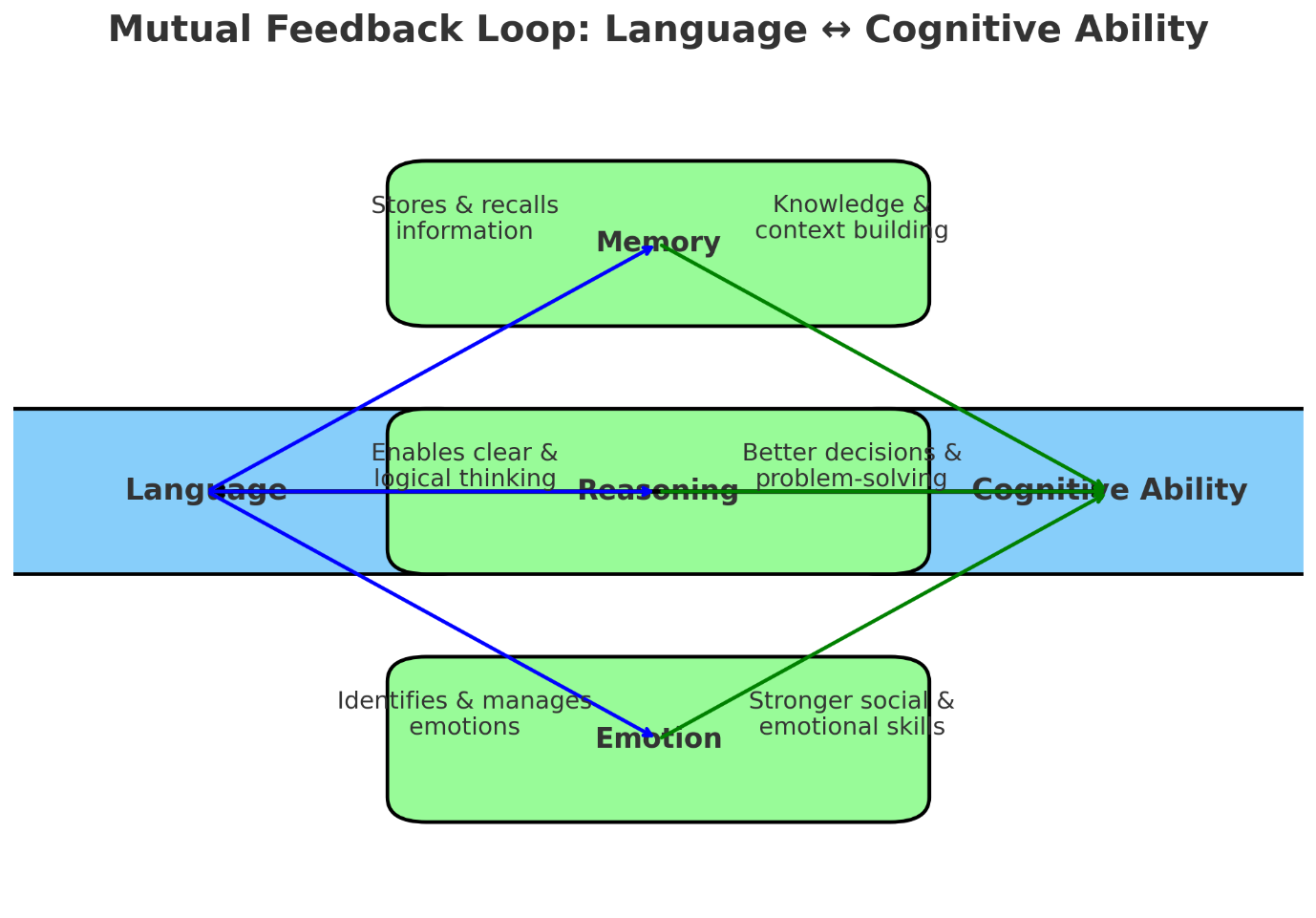
Links between language and cognitive ability
- Language Shapes Thought (Linguistic Relativity)
- The words and structures available in a language influence how its speakers perceive and interpret the world.
- Known as the Sapir–Whorf Hypothesis: this idea suggests that different languages can lead to different cognitive patterns.
- Example: Some languages have multiple words for “snow” or “blue,” leading speakers to notice finer distinctions when looking at items in those categories.
- Language as a Cognitive Tool
- Encoding knowledge (language lets us label, organise and store information in memory more efficiently.)
- Problem-solving (talking or thinking through language allows abstract concepts to be manipulated mentally.)
- Metacognition (language enables us to think about our own thinking (“I realise I don’t understand this step yet…”).
- Language and Memory
- Verbal labels (help encode and retrieve experiences; without language, many memories remain vague.)
- Storytelling (improves retention by linking information into structured, meaningful narratives.)
- Changing language can change how we remember events eg, using “bumped” rather than “smashed” in eyewitness testimony experiments altered witnesses’ speed estimates).
- Language and Reasoning
- Complex grammar and vocabulary (allows for conditional reasoning, ie “If X, then Y”) and hypotheticals “What if…”)
- Argumentation, persuasion and negotiation (all depend on cognitive ability expressed through precise language.)
- Misuse or misunderstanding of language (can lead to flawed reasoning or poor decision-making.)
- Language Development and Cognitive Growth
- Vocabulary growth and language mastery (in children, these elements are strongly correlated with cognitive milestones such as problem-solving, planning, emotional regulation, etc).
- Bilingualism (can enhance cognitive flexibility, attention control and task-switching abilities due to constant language management.)
- Emotional and Social Cognition
- Language is central to recognising, labelling and regulating emotions (“I feel anxious” as distinct from vague unease).
- Social problem-solving (it depends on clear communication, ie both understanding others’ intent and expressing one’s own.)