The Attributes of Kind Leadership
There are around 20 attributes of kind leadership of which 7 are core; these are empathy, emotional intelligence, integrity, humility, active listening, accountability and courage.
- Empathy and understanding
“…Empathy is about finding echoes of another person in yourself...”
Mohsin Hamid as quoted by Hacking HR, 2025
- Definition (the ability to understand and share the feelings of others, ie genuine care of how others feel.)
- In leadership (empathy allows leaders to connect with team members on a human level, understand their motivations and respond to personal and professional challenges with compassion.)
Understanding other's perspectives, struggles and motivation.
- Why it matters:
- Increases trust and loyalty
- Prevents disengagement or burnout
- Helps resolve conflict constructively
- Example (a leader notices a team member is unusually quiet and checks in privately to offer support.)
- Emotional Intelligence (EI)
“…No doubt emotional intelligence is more rare than book smarts, but my experience says it is actually more important...”
Jack Welch as quoted by Hacking HR, 2025
- Definition (the ability to recognize, understand, manage and influence emotions — both your own and others’.)
- In leadership (high EI enables leaders to remain calm under pressure, manage interpersonal dynamics and handle feedback or conflict with grace.)
- Why it matters:
- Supports resilience and decision-making
- Enhances collaboration
- Prevents reactive, emotionally-charged responses
- Example (after receiving harsh criticism, a leader takes time to reflect before responding with professionalism and openness.)
- Integrity
“…Integrity is doing the right thing, even when no one is watching...”
C.S. Lewis as quoted by Hacking HR, 2025
- Definition (acting consistently with ethical principles, honesty and fairness.)
- In leadership (integrity means being truthful, honouring commitments and aligning actions with values, especially when it’s inconvenient.)
- Why it matters:
- Builds credibility and trust
- Sets ethical standards for the team
- Prevents reputational and moral risk
- Example (a leader owns up to a mistake publicly and outlines how it will be corrected.)
- Humility
“…Humility is not thinking less of yourself, but thinking of yourself less...”
C.S. Lewis as quoted by Hacking HR, 2025
- Definition (a modest view of one’s importance; openness to learning from others.
- In leadership (humble leaders seek input, admit limitation and give credit generously — creating environments where others feel valued.)
- Why it matter:
- Encourages collaboration and learning
- Reduces ego-driven decisions
- Strengthens psychological safety
- Example (a leader invites junior team members to challenge their ideas and listens without defensiveness.)
- Active Listening
“…Most people do not listen with the intent to understand; they listen with the intent to reply..”
Stephen R. Covey as quoted by Hacking HR, 2025
- Definition (fully focusing, understanding and responding to others without interrupting or pre-judging.)
- In leadership (active listening makes team members feel seen, heard and respected; it enhances morale and problem-solving; it involves actively listening to others, ie listening more than you speak.)
- Why it matters:
- Builds deeper trust and rapport
- Uncovers issues early
- Reduces miscommunication
- Example (in a tense meeting, the leader restates a team member’s concern before offering their view.)
- Accountability
“…Leadership is not about being in charge. It’s about taking care of those in your charge...”
Simon Sinek as quoted by Hacking HR, 2025
- Definition (taking responsibility for decisions, behaviours and outcomes; holding others to agreed-upon standards.)
- In leadership (kindness includes clear expectations and follow-through, not overlooking underperformance or unfairness.)
- Why it matters:
- Promotes a culture of ownership and fairness
- Increases reliability and consistency
- Encourages high standards and mutual respect
- Example (leader addresses a broken team commitment promptly but constructively.)
- Courage
“…You can choose courage or you can choose comfort. You cannot have both...”
Brené Brown as quoted by Hacking HR, 2025
- Definition (the willingness to take risks, speak up, or act despite fear or difficulty.)
- In leadership (courage means leading with authenticity and values, especially when it’s inconvenient, unpopular or risky.)
- Why it matters:
- Enables ethical decision-making
- Helps confront toxic behaviour or injustice
- Inspires teams to do what’s right over what’s easy
- Example (leader calls out unethical practices in an organisation, risking backlash but protecting integrity.)
Summary Table
|
Attribute |
What It Enables in Leadership |
|
Empathy |
Connection, trust, compassionate responses |
|
Emotional Intelligence |
Self-regulation, social awareness, conflict management |
|
Integrity |
Credibility, ethical alignment, consistency |
|
Humility |
Openness, inclusiveness, shared learning |
|
Active Listening |
Psychological safety, better decisions, deeper engagement |
|
Accountability |
Clarity, fairness, team reliability |
|
Courage |
Ethical stands, innovation, truth-telling |
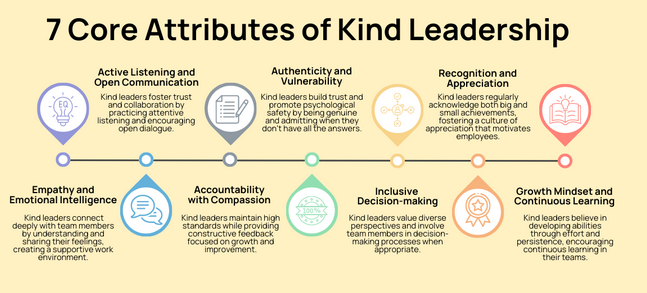
(source: Hacking HR, 2025)