More on Intuition
Introduction
Intuition is defined as
“…the learned, productive use of unconscious information to improve decisions or actions…”
Joel Pearson as quoted by Euan Black, 2024
Intuition is:
- Learned: Built from accumulated experiences and knowledge.
- Productive: Leads to beneficial outcomes.
- Unconscious: Operates below the level of conscious awareness.
This form of intuition is closely linked to interoception, ie our ability to sense internal bodily states, which often manifests as a ‘gut feeling’.
Intuition is more than emotional thinking or cognitive bias or superstition but legitimate and powerful tool, if used correctly.
Intuition can be very useful when you are dealing with imperfect information and need to make a quick decision.
It is a
“…feeling that is derived from your brain unconsciously processing hundreds of data points…”
Euan Black, 2024e
It is based on past learning.
Intuition is different from emotional impulses, biases or superstitions; these has been termed “misintuition.”
However, there are 5 scenarios of which to be careful when using intuition, ie use SMILE framework or acronym to help individuals harness intuition effectively.
The SMILE Framework
S – Self-awareness (avoid relying on intuition when experiencing strong emotions like stress or fear, as these can cloud judgment.)
M – Mastery (intuition is reliable in areas where one has substantial experience and expertise.)
I – Impulses and Addiction (differentiate between genuine intuition and impulsive desires or addictive behaviours; the latter should not be mistaken for intuitive insights.)
L – Low Probability (be cautious of using intuition for rare or probabilistic events, where it may be misleading.
“… Humans are instinctively bad at understanding probability and therefore must not use their intuition for probabilistic judgements…”
Euan Black, 2024e)
E – Environment (trust intuition primarily in familiar and predictable settings or context.)
This framework provides a structured approach to discern when to trust one's gut feelings and when to rely on analytical thinking. It highlights the importance of context in decision-making.)
A variation of SMILE
S – Stop
- Pause and be present.
- In moments requiring decision or insight, the first step is to stop automatic responses and reactions.
- This creates mental space to access deeper, intuitive processing.
- Mindfulness and self-awareness are essential here.
M – Manage emotions
- Recognise and regulate emotions, which can distort or block intuition.
- Emotions such as fear, stress, or excitement can cloud your judgment.
- Techniques like breathing, reflection, or emotional labelling can help clarify what you're feeling and separate emotion from intuition.
I – Intuition scan
- Actively scan for intuitive signals.
- Intuition often appears as a subtle bodily feeling (a “gut feeling”), image or thought.
- Ask yourself: “What is my gut telling me?” or “What feels right or wrong about this?”
- This stage involves accessing non-conscious knowledge or patterns your brain has learned.
L – Learn from feedback
- After acting on your intuition, evaluate the outcome.
- Was the intuition helpful or not?
- This feedback loop improves your intuitive accuracy over time.
- Reflective practice is key to distinguishing useful intuition from bias or noise.
E – Execute
- Act decisively, based on a balanced integration of intuition and logic.
- Once you’ve gone through the prior steps, commit to a course of action.
- Don’t get stuck in overthinking—trust your trained intuition when appropriate.
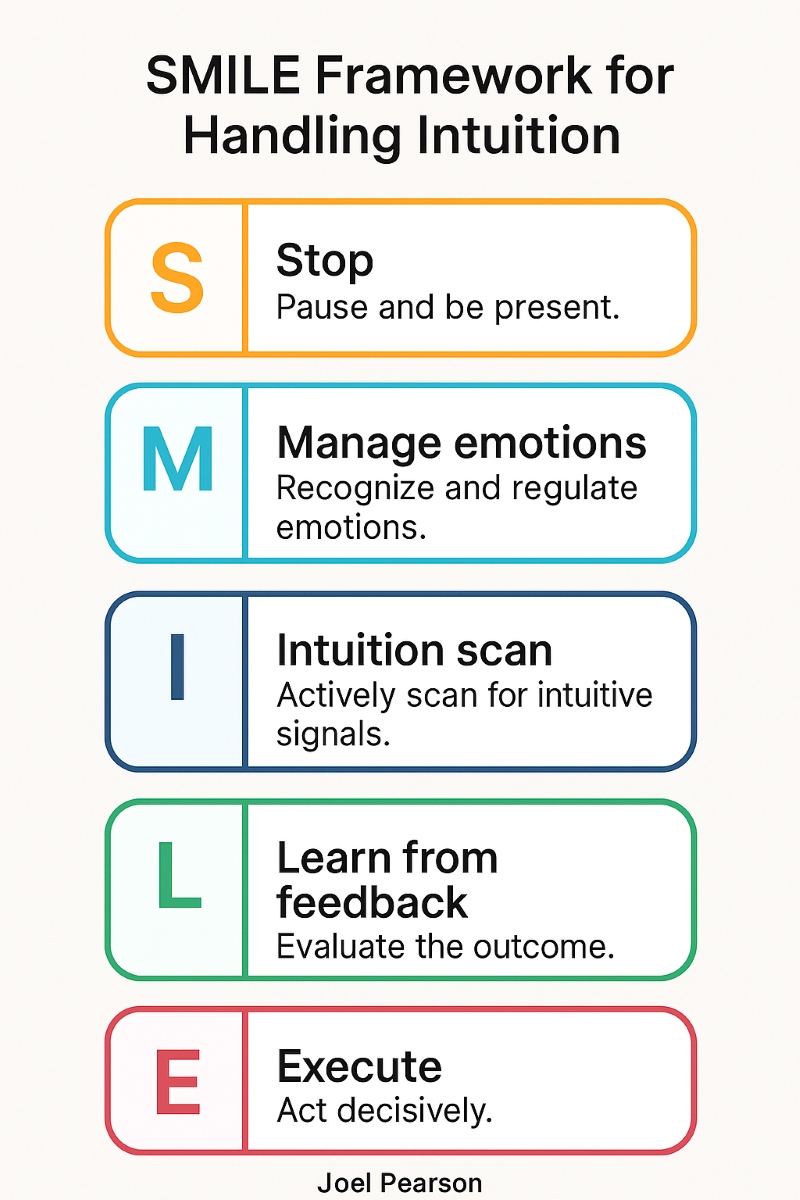
The SMILE framework supports practical use of intuition by blending neuroscience, emotional regulation and reflective decision-making. It helps individuals avoid impulsive reactions while learning to trust and refine their intuitive abilities.
Summary
- Intuition is trainable (by understanding and applying the SMILE principles, individuals can enhance their intuitive decision-making.)
- Context matters (intuition is most reliable in areas of personal expertise and familiar environments.)
- Beware of mis-intuition (recognize and avoid common pitfalls where intuition may be misleading.)
NB
“…The bulk of everything your brain processes is unconscious and so a good way to think about intuition is learning to tap into that vast reservoir of information……The key is, how can you know when to trust it and when not to trust it?...”
Joel Pearson as quoted by Euan Black, 2024e