Male Insecurity
Introduction
Male insecurity refers to a set of thoughts, feelings or behaviours driven by a man’s perception that he is not measuring up—socially, physically, emotionally or professionally—against his own expectations or those of others; often tied to traditional expectations of masculinity that often manifests in specific ways shaped by cultural expectations around masculinity.
The basis for this insecurity is changing the place of men in the world, ie the perception of traditional masculinity is under threat.
This has been caused by an increasing focus on gender issues around diversity, inclusivity, collaboration, # MeToo movement, pay gap, feminisation, etc
Insecurity around work performance is often labelled imposter syndrome. Even though the term was coined in the late 1970s about high performance women, it is applicable to men:
“…Research in 2024 found 62% of men say they experienced imposter syndrome, compared to only 46% of women…”
Peter Quarry, 2024
Male insecurity goes beyond the office
“… Some 60% of men feel insecure about dating. They mainly feel rejection based on their age and appearance, but also feel more generalised uncertainty now that the rules of engagement have change. I hear many variations of ‘I just don't know how to be a man any more’…”
Peter Quarry, 2024
in addition, there are childhood experiences which contribute to later insecurity, ie criticising parents and being bullied. This can make a child feel unsafe and unloved.
Common Sources of Male Insecurity
- Physical Appearance
- Concerns about height, hair loss, muscle tone, weight or aging.
- Society often pressures men to appear strong, fit, or "masculine."
- May lead to overcompensation (e.g., extreme fitness routines or avoidance of certain social situations)
- Career and Success
- Many men tie self-worth to status, income and professional achievement.
- Pressure to succeed, earn more, or lead.
- Fear of failure or being outperformed by peers can create anxiety and self-doubt.
- Emotional Expression
- Boys are often taught to suppress emotion ("boys don’t cry").
- This can lead to emotional isolation or difficulty articulating feelings—especially to hide vulnerability.
- Relationship Performance
- Fear of not being a “good enough” partner, lover or provider.
- Insecurity around sexual performance, emotional intimacy or being replaced.
- Social Status and Masculine Identity
- Constant pressure to prove toughness, confidence, leadership or dominance.
- Some men may feel insecure if they don’t conform to traditional masculine roles.
More on overcompensation
“… Overcompensation is the urge to exaggerate one aspects of your life to make up for real or imagined deficit in another. Overcompensation occurs when a person goes way beyond what is necessary to correct deficiency…”
Peter Quarry, 2024
Research has confirmed that it has its basis in Freudian psychology:
“…One study found that if you trigger men to feel insecure about their masculinity, they will display more homophobic attitudes, more likely to support a war and are more inclined to buy a big, macho car…”
Peter Quarry, 2024
“… Men are under very strong prescriptive norms to be a certain way and they work hard to correct the image they project when their masculinity is under threat…”
Benoit Monin as quoted by Peter Quarry, 2024
When men are informed that they have a low score of masculinity, they are more likely to act aggressively.
How It Shows Up (Behaviours and Signs)
- Overcompensating with bravado or aggression
- Seek to ing validation through material things or attention
- Difficulty accepting criticism
- Avoidance of vulnerability or openness
- Jealousy or possessiveness in relationships
- Dismissing or belittling others to elevate oneself
Healthy Ways to Address Male Insecurity
- Self-awareness and reflection
- Recognise internalised beliefs about manhood and success.
- Question whether these standards are truly your own.
- Emotional intelligence
- Learn to name and express feelings.
- Build comfort with vulnerability and emotional risk.
- Building secure relationships
- Surround yourself with people who encourage honesty and growth.
- Practice open, supportive communication.
- Redefining masculinity
- Embrace a broader version of manhood that includes softness, care and imperfection.
- Remember: strength also means knowing when to ask for help.
Final Thought
Male insecurity isn’t weakness—it's quintessential humanity.
Insecurity doesn’t make you weak—avoiding it does. Facing it makes you stronger and more real.
You don’t have to be invulnerable to be respected. You just have to be authentic.
However, if left unchecked, being undermined by feelings of my insecurity can block connection, confidence and growth. Addressing it with empathy (for oneself and others) can lead to stronger, healthier masculinity.
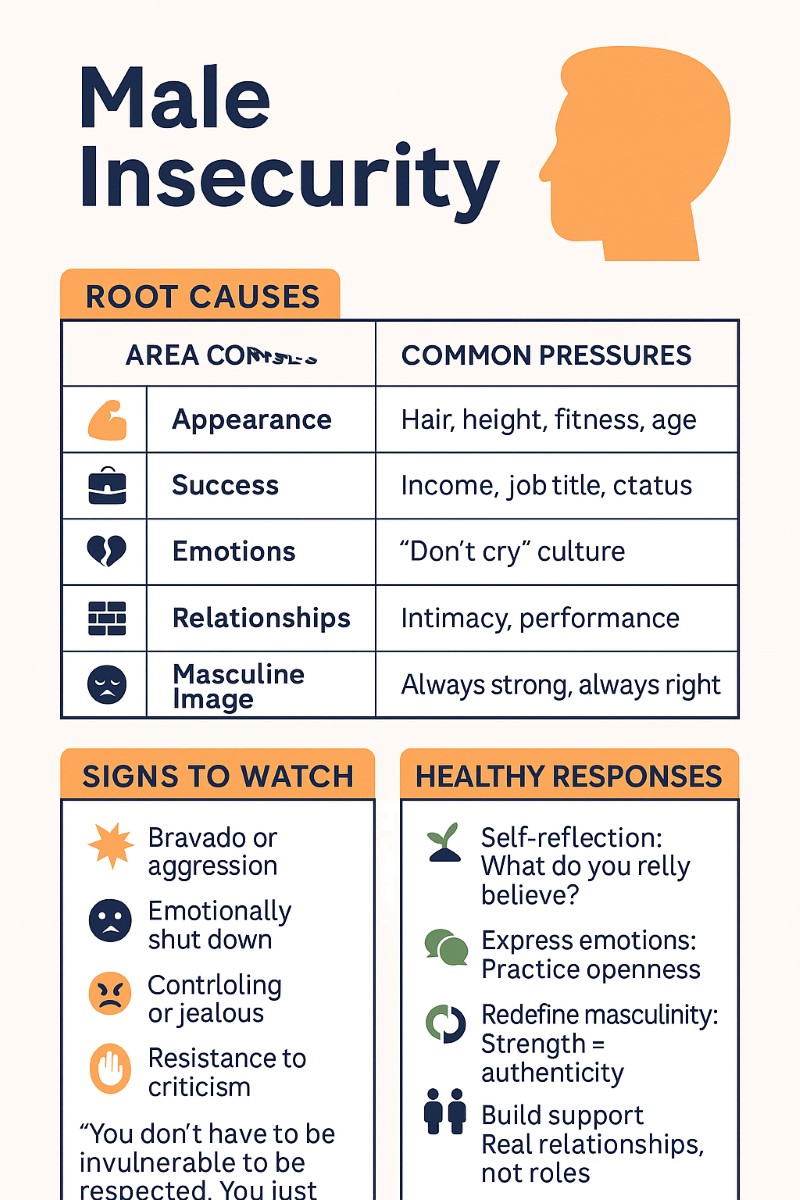
Summary
Male Insecurity at a Glance
Root Causes
|
Area |
Common Pressures |
|
Appearance |
Hair, height, fitness, age |
|
Success |
Income, job title, status |
|
Emotions |
“Don’t cry” culture |
|
Relationships |
Intimacy, performance |
|
Masculine Image |
Always strong, always right |
Signs to watch
- Bravado or aggression
- Emotionally shut down
- Avoiding vulnerability
- Controlling or jealous
- Resistance to criticism
Healthy response
- Self-reflection: What do you really believe?
- Express emotions: Practise openness
- Redefine masculinity: Strength = authenticity
- Build support: Real relationships, not roles.