More on Complex Systems
Introduction
The concept of complex systems refers to systems made up of many interconnected parts that interact in non-linear, dynamic and often unpredictable ways.
These systems cannot be fully understood by analysing individual components in isolation, because the whole behaves differently from the sum of its parts:
“…Critically important information resides in the relationship between the parts and not necessarily within the parts themselves…”
Chris Antonopoulos, 2016
Examples of Complex Systems
|
Domain |
Example |
|
Nature |
Ecosystems, weather systems, etc |
|
Society |
Economies, traffic, language, cultures, social networks |
|
Technology |
The internet, power grids |
|
Biology |
Human brain, immune systems |
|
Organizations |
Companies, governments, education systems |
Key Characteristics of Complex Systems
|
Feature |
Description |
|
Emergence |
Unexpected patterns arise from simple rules (e.g., ant colonies, team culture) |
|
Non-linearity |
Small changes can lead to big effects (and vice versa) |
|
Feedback loops |
Outcomes can reinforce (positive feedback) or balance (negative feedback) the system |
|
Adaptation |
The system or its parts change in response to the environment (e.g., evolution, learning) |
|
Decentralization |
No single controller, as decisions come from local interactions |
|
Self-organization |
Structure arises without central planning (e.g., schools of fish, market dynamics) |
Simple vs. Complicated vs. Complex
|
Type |
Description |
Example |
|
Simple |
Easy to understand; repeatable |
Baking a cake with a recipe |
|
Complicated |
Predictable but requires expertise |
Building a rocket |
|
Complex |
Unpredictable, adaptive, emergent |
Leading a company through crisis |
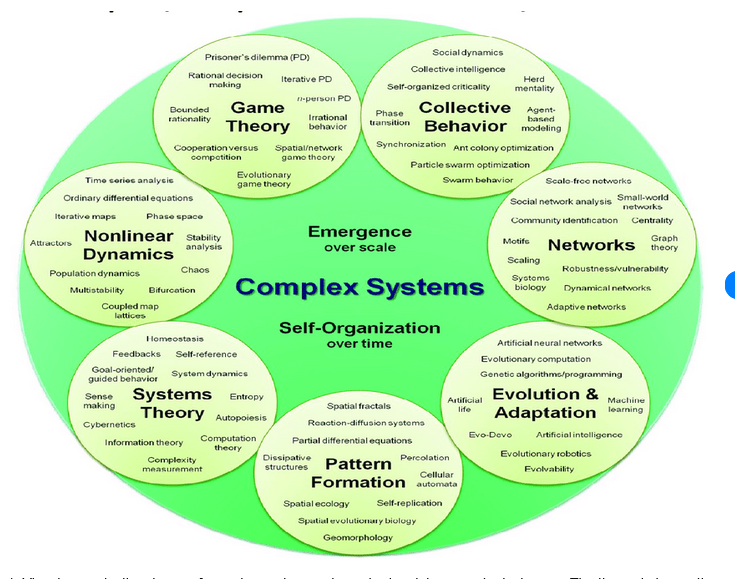
A complex system
(source: Chris Antonopoulos, 2016)
The above diagram described the complex system broken into 2 core concepts and 7 component areas:
Core Concepts
Two core concepts (emergence and self-organising) form the background for 7 components:
i) emergence (this describes the relationship between the macro and micro levels, ie different scales:
"... If you observe a property at a macroscopic scale that is fundamentally different from what you would naturally expect from microscopic rules, then you are witnessing the emergence......macroscopic properties are called emergent when it is hard to explain them simply from microscopic properties..."
Chris Antonopoulos, 2016
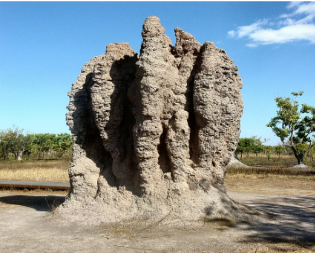
For example, a termite mound produced by a termite colony is a classic example of emergence in nature (see photo below).
(source: Wikipedia as quoted by Chris Antonopoulos, 2016)
ii) self-organising (it is about time and scale
"...You observe that the system spontaneously organises itself to produce non-trivial macroscopic structure and/or behaviour (or order) as time progresses..."
Chris Antonopoulos, 2016
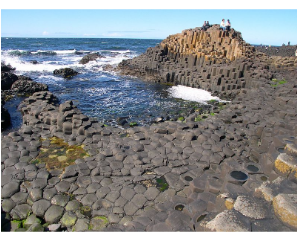
For example, The Giants Causeway in Northern Ireland is an example of a complex emergent self-organising structure created by natural processes over time.
(source: Wikipedia as quoted by Chris Antonopoulos, 2016)
Seven components
The 7 components (the 3 on the left of the diagram above - game theory, nonlinear dynamics and systems theory - provide the historical background; the other 4 - pattern formation, evolution and adaptation, networks and collective behaviour - are more recent additions.)
i) game theory (it formulates decisions and behaviours of people playing games with each other; it is assumed rational so that it is possible to formulate decision-making processes of a kind of deterministic dynamic system in which decisions themselves or the probabilities can be determined; has a huge influence on a range of topics from economics to evolutionary biology.)
ii) nonlinear dynamics (this means that outputs on the system are given by non--linear combinations of inputs, ie no analytical solutions are generally available; for example, chaos theory)
iii) systems theory (originated from engineering disciplines where they were facing real world complex problems and developed techniques to handle them. Some examples:
"...- Alan Turing's foundation work on theoretical computer science
- Norbet Wiener's cybernetics and
- Claude Shannon's information and communication theories..."
Chris Antonopoulos, 2016)
iv) pattern formation (self-organising system that involves space and time; it
"...is made up of a large number of components that are distributed over a spatial domain and their local interactions create an interesting spatial pattern over time..."
Chris Antonopoulos, 2016)
v) evolution and adaptation (general mechanism that explains biological processes and others that have dynamic learning and creative abilities; some examples include evolutionary biology and complex adaptive systems which involve evolutionary computations, artificial neural networks plus man-made adaptive systems which are inspired by biological and neurological processes)
vi) & vii) networks & collective behaviour (Big Data is providing the data to analyse:
“…- how people are connecting to each other
- how they are communicating with each other
- how they are moving geographically, etc…”
Chris Antonopoulos, 2016
This allows analysing network structures at different levels and collective behaviour.)
Context in Which Complex Systems Matter
- In leadership & change (you can’t control everything—leaders must sense patterns, support adaptation, be flexible and work with uncertainty.)
- In policy-making (realise that a simple fix may backfire due to ripple effects.)
- In technology (interconnected components, like in AI or cybersecurity, require systemic thinking.)
How to Work with Complex Systems
|
Practice |
Why it Helps |
|
Systems thinking |
Understanding relationships and feedback enhanced |
|
Experimentation |
Try small changes to learn from results; encourage flexibility |
|
Resilience building |
Strengthens the system’s ability to adapt |
|
Facilitation & dialogue |
Multiple perspectives emerge |
|
Sensemaking |
Helps interpret ambiguity and emergence |
Example: A School as a Complex System
- Teachers, students, parents, community, policy-makers, etc all interact.
- Changing one policy (eg homework) can have unexpected ripple effects.
- School culture and student performance emerge from these daily interactions, not just top-down rules.
Summary
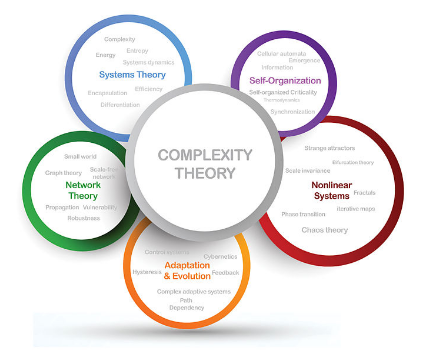
Understanding the 2 core elements (emergence and self-organising) and their 7 components (game theory, nonlinear dynamics and systems theory, pattern formation, evolution and adaptation, networks and collective behaviour) can help you prepare for unexpected and unpredictable system behaviours that will appear counter-intuitive to everyday understanding in all environments, eg physical, biological, technological, political, social, organisational, etc.
"...Complex systems can be informally defined as networks of many interacting components that may arise and evolve through self-regulation......complex systems......are everywhere......a massive amount of microscopic components are interacting with each other in non-trivial ways, where important information resides in the relationships between parts and not necessarily within the parts themselves..."
Chris Antonopoulos, 2016
(source: Chris Antonopoulos, 2016)