Elements of the Customer Value Pyramid
At times what customers value can be difficult to determine. However, there are some universal building blocks that in the right combination will pay off in
“…stronger customer loyalty, greater consumer willingness to try a particular brand and sustained revenue growth…”
Eric Almquist et al, 2016
This goes beyond pricing and cost management which can have too much focus.
The value of a particular product or service is based upon the customer's perceptions which can vary between customers and over time
This builds on Maslow's ‘hierarchy of needs’, ie
“…human actions arise from an innate desire to fulfill needs ranging from the very basic (security, warmth, food, rest) to the complex (self-esteem, altruism)…”
Eric Almquist et al, 2016
(for more details, see elsewhere in Knowledge Base)
Consideration of Maslow's ‘hierarchy of needs’ plus treating people as consumers, helped formulate 30 elements of value that are divided into 4 basic needs; these can be arranged as a hierarchical pyramid (see diagram below):
i) Functional (basic elements that address practical needs, such as saving time, reducing effort or simplifying processes, etc.)
ii) Emotional (elements that fulfill emotional needs, including reducing anxiety, providing entertainment, offering aesthetic appeal. etc.)
iii) Life-Changing (elements that have a significant impact on a consumer's life, such as providing hope, motivation, a sense of belonging. etc.)
iv) Social Impact (elements that enable consumers to contribute to society, like by supporting ethical practices, environmental sustainability, etc).
These basic needs can be either focused inwardly, eg motivation, and/or externally, eg being visually appealing)
Enlarging on the 4 needs (with further examples)
1. Functional Elements (Base Level)
These elements address practical and utilitarian needs:
● Saves Time (helps consumers accomplish tasks more quickly.)
Example: Amazon Prime offers expedited shipping, saving customers time on deliveries.
● Simplifies (makes processes or experiences easier to navigate.)
Example: TurboTax streamlines the tax filing process, making it easier for users to complete their taxes.
● Makes Money (assists in generating income or financial gain.)
Example: eBay enables users to sell items online, providing a platform to earn money.
● Reduces Risk (minimizes potential losses or uncertainties.)
Example: LifeLock offers identity theft protection services, reducing the risk of personal data breaches.
● Organizes (helps structure or arrange tasks and information.)
Example: The Container Store provides storage solutions that help customers organize their spaces.
● Integrates (combines various functions or systems seamlessly.)
Example: Apple's ecosystem allows seamless integration between devices like iPhones, iPads, and Macs.
● Connects (facilitates interactions between people or systems.)
Example: Facebook connects people globally, facilitating communication and social interaction.
● Reduces Effort (lessens the amount of work required.)
Example: Roomba robotic vacuums automate floor cleaning, reducing the effort required by users
● Avoids Hassles (eliminates common inconveniences or obstacles.)
Example: Netflix eliminates the need to visit rental stores by providing streaming services at home.
● Reduces Cost (lowers expenses for the consumer.)
Example: Costco offers bulk purchasing options, helping customers save money on goods.
● Quality (ensures a high standard of performance or durability.)
Example: Toyota is renowned for manufacturing reliable and high-quality vehicles
● Variety (offers a range of options to choose from.)
Example: Spotify provides access to a vast library of music across various genres.
● Sensory Appeal (provides pleasing sensory experiences.)
Example: Lush offers handmade cosmetics with appealing scents and textures.
● Informs (delivers useful information or insights.)
Example: WebMD provides health-related information to educate users about medical conditions.
2. Emotional Elements
These elements fulfill emotional needs and enhance personal experiences:
● Reduces Anxiety (alleviates stress or worry.)
Example: ADT offers home security systems that help alleviate homeowners' safety concerns.
● Rewards Me (provides a sense of gratification or benefit.)
Example: Starbucks Rewards program offers perks and free items to loyal customers.
● Nostalgia (evokes positive memories from the past.)
Example: Nintendo's classic game consoles evoke nostalgic feelings among users.
● Design/Aesthetics (offers visually appealing or well-designed products.)
Example: Dyson products are known for their sleek and modern design.
● Badge Value (serves as a symbol of status or achievement.)
Example: Owning a Rolex watch is often seen as a status symbol.
● Wellness (promotes health and well-being.)
Example: Fitbit devices promote health and wellness by tracking physical activity
● Therapeutic Value (provides comfort or relief.)
Example: Headspace offers guided meditation to improve mental well-being.
● Fun/Entertainment (delivers enjoyment or amusement.)
Example: Disney+ provides a wide range of entertainment options for all ages.
● Attractiveness (enhance a consumer's physical appeal or self-perception of attractiveness; can boost confidence and satisfaction)
Example: Sephora offers beauty products that enhance personal appearance.
● Provides access (it reflects the value consumers place on the ease of obtaining products, services, or information that might otherwise be difficult to access.)
Example: CVS Health's in-store clinics offer accessible healthcare services to communities.
3. Life-changing Elements
These elements have a significant impact on a consumer's life:
● Provides Hope (inspires optimism about the future.)
Example: TOMS Shoes donates a pair of shoes for every pair sold, instilling hope in underprivileged communities.
● Self-Actualization (helps realize personal potential or goals.)
Example: MasterClass offers courses taught by experts, helping individuals achieve personal growth.
● Motivation (encourages action or personal growth.)
Example: Nike's "Just Do It" campaign inspires customers to pursue their fitness goals.
● Heirloom (creates a lasting legacy or value over time.)
Example: Tiffany & Co. Jewellery is often passed down through generations as cherished heirlooms.
● Affiliation and Belonging (fosters a sense of community or connection.)
Example: Peloton is a fitness brand has cultivated a strong sense of community through its live-streamed and on-demand workout classes.
4. Social Impact (Top Level)
This element enables consumers to contribute to society:
● Self-Transcendence (provides a sense of purpose beyond oneself, contributing to the greater good, including social responsibility.)
Example: Patagonia encourages environmental activism and responsible consumption.
(see diagram below)
By understanding and delivering on these elements, companies can better meet consumer needs, differentiate their offerings and build stronger customer relationships.
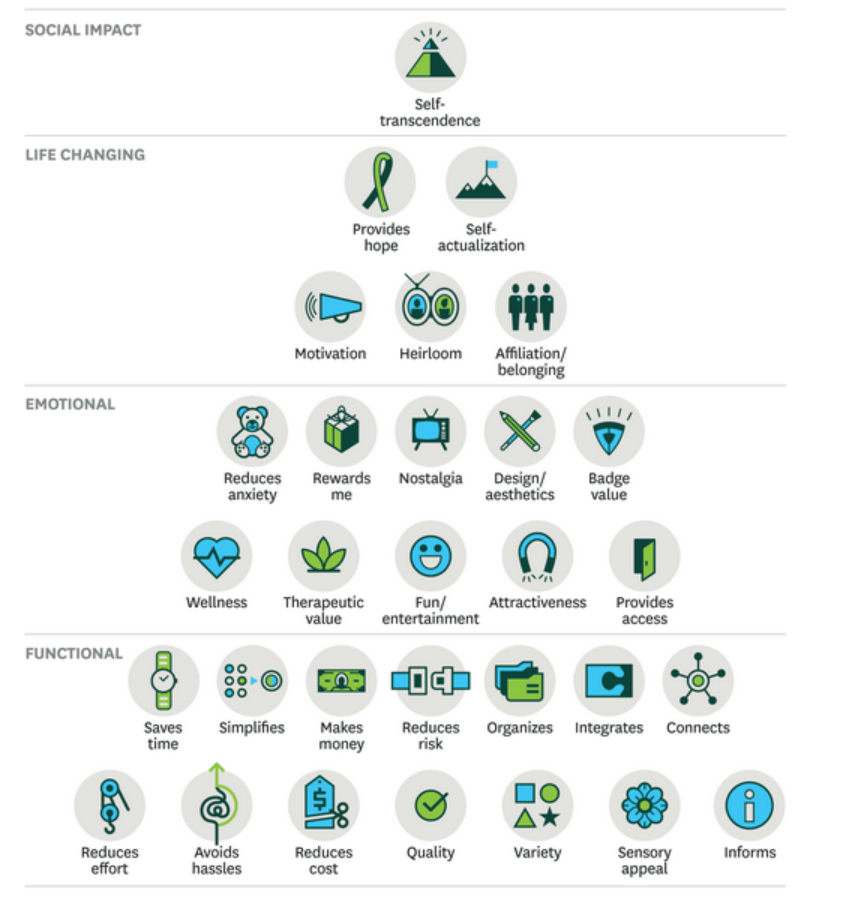
(source: Eric Almquist et al, 2016)
Organisations delivering more of these elements, especially those higher up the pyramid, tend to foster stronger customer loyalty and achieve sustained revenue growth. By understanding and targeting the specific elements that resonate with their customer base, organisations can enhance their value propositions and differentiate themselves in competitive markets.