Four Categories of Causes of Resistance
1. Psychological (involves negative attitudes/perceptions, frustration, anxiety, preference towards status quo, cognitive discomfort, fear, past failure, cynicism, mistrust of management, etc.)
2. Materialistic (involves loss of pay, comfort, status, threat to job security, etc.)
3. Employees' current capabilities (they feel no longer suitable; this involves existing their expertise, knowledge, skills, routines, rules & regulations, systems, processes etc )
4. Current organisational culture (it is not able to adapt to the proposed changes; this involves differing perceptions, objectives, targets, etc; there are 2 sub-types:
- procedural conflict, ie conflict of approaches (different work procedures, ie for performing the tasks to achieve goals; different work procedures imposed by the organisation, as part of the change, may not be preferred by employees who favour their own style of working, ie employees have their own and different priorities)
- goal conflicts (differing expectations, ie targets, etc from different stakeholders; need to understand the degrees of compatibility and variability of goals at different levels of the organisation from organisation to individuals; goals can be divided into 2 types:
a) primary (organisational and personal, ie need to have a high degree of compatibility or convergence between the 2 for change to be effective, eg satisfying personal claims for a higher remuneration and better working conditions may improve productivity and thus provide the organisation with greater resources and profits)
b) secondary or support to the primary
"...The increased commitment of a firm towards obtaining its new goal leads to the differences between firm goals and employees' goals towards conflict...... firms may not change its goals but increase its activities and focus/concentration on achieving those goals. The firm's increased concentration and one-sided focus on its goals affects employees' personal goals, and it may become very difficult for employees to achieve their own goals and satisfy their own needs..."
Ajayi Samson Adeniyi, 2022
This can create a situation of goal conflict between the organisation and individuals, ie individuals will feel that the organisational goals are incompatible and conflicting with their own goals and needs, making it difficult to achieve them.
NB Generally personal goals are more influential than organisational, ie if there is a conflict, your personal ones will dominate.)
Causes of employees’ resistance to change can be described as a formula and/or diagrammatically
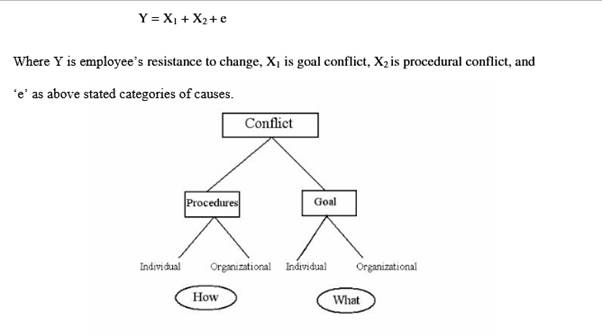
(main source: Ajayi Samson Adeniyi, 2022)
An example of what contributes to employees' resistance to organisational change in an ICT firm (Airtel Network Limited) and the change initiative’s resultant failure.
"...i) the employees were strongly not supportive of the change process, dynamics of the change, reasons for the change and the method through which the employers went about introducing the change in the organisation
ii) the measures taken by the management for the introduction of the proposed change were drastic and without proper due process
iii) on the other hand, the views of the managers/supervised varied from employees, they were more concerned with the outcome of the business rather than their employees, contravening the principle of employee first in the organisation
iv) the reason for the introduction of the major changes in the organisation was not adequately communicated nor understood by the employees
v) employees were not properly motivated to affect changes
vi) the reason for the resistance was also jarring for some managers who considered it inhuman..."
Ajayi Samson Adeniyi, 2022
NB The main reason for the change in this ICT firm was to increase the quality of services offered to the customers.
Some recommendations based on the findings for this ICT for a successful change:
- need to prepare for handling potential resistance
- need alignment of personal and organisational goals
- introduce appropriate motivations to increase acceptance of the change
- encourage open communications between all stakeholders about the necessity to change, its impact, progress, problems, ideas, solutions, etc
- encourage detailed, readable documentation as a basis for regular monitoring and evaluating the change progress and performance; some examples:
i) document a functional description that describes the pros and cons of the change program, what it can do, how it works, and how it solves problems, etc
ii) risk analysis
- develop suitable professional and personal training programs.
Summary (resistance to change)
“...Resistance is a phenomenon that affects the change process, delaying or slowing down its beginning, obstructing or hindering its implementation, and increasing its costs……It can also be described as any conduct that tries to keep the status quo, that is to say, resistance is equivalent to inertia, as the persistence to avoid change……So, inertia and thus resistance are not negative concepts in general, since change is not inherently beneficial for organizations. Even more, resistance could show change managers regarding certain aspects that are not properly considered in the change process...”
Joseph Bengat, et al, 2015